The Concession Golf Clubhouse

Capturing the essence of Palladian architecture, The Concession Golf Clubhouse has now opened its doors and is graciously welcoming residents and enthusiastic golfers. Refreshingly elegant, The Clubhouse was expertly designed to introduce a new golf clubhouse concept utilizing an innovative color palette, sophisticated finishes and a brilliant use of space allowing for breathtaking golf course views from every interior room.


Working closely with the developer, Kevin Daves, the building was designed to be a contemporary interpretation of the work of Andrea Palladio, the 15th C. architect, featuring dramatic symmetry and the vocabulary of classic Italian architecture. Sweeping loggias on the front and rear of the building provide welcomed shade from the sun, while maximizing outdoor living space for year round enjoyment of this serene location.


International fashion designer Adrienne Vittadini and Hughes Design Associates worked together to create a stimulating interior, breaking the traditional themes usually applied to grand scale country clubs. The designers are responsible for all of the interior design of The Clubhouse, as well as all of the furnishings and finishes.


Entering The Clubhouse, the welcoming foyer features a vaulted ceiling and gracefully faux-finished walls, complementing the elegant stone floors with subtle contrasting inlays. This dramatic reception area, with a subtle reference to the soft elegance of Tuscany, provides access to the main living room as well as to the golf corridor.


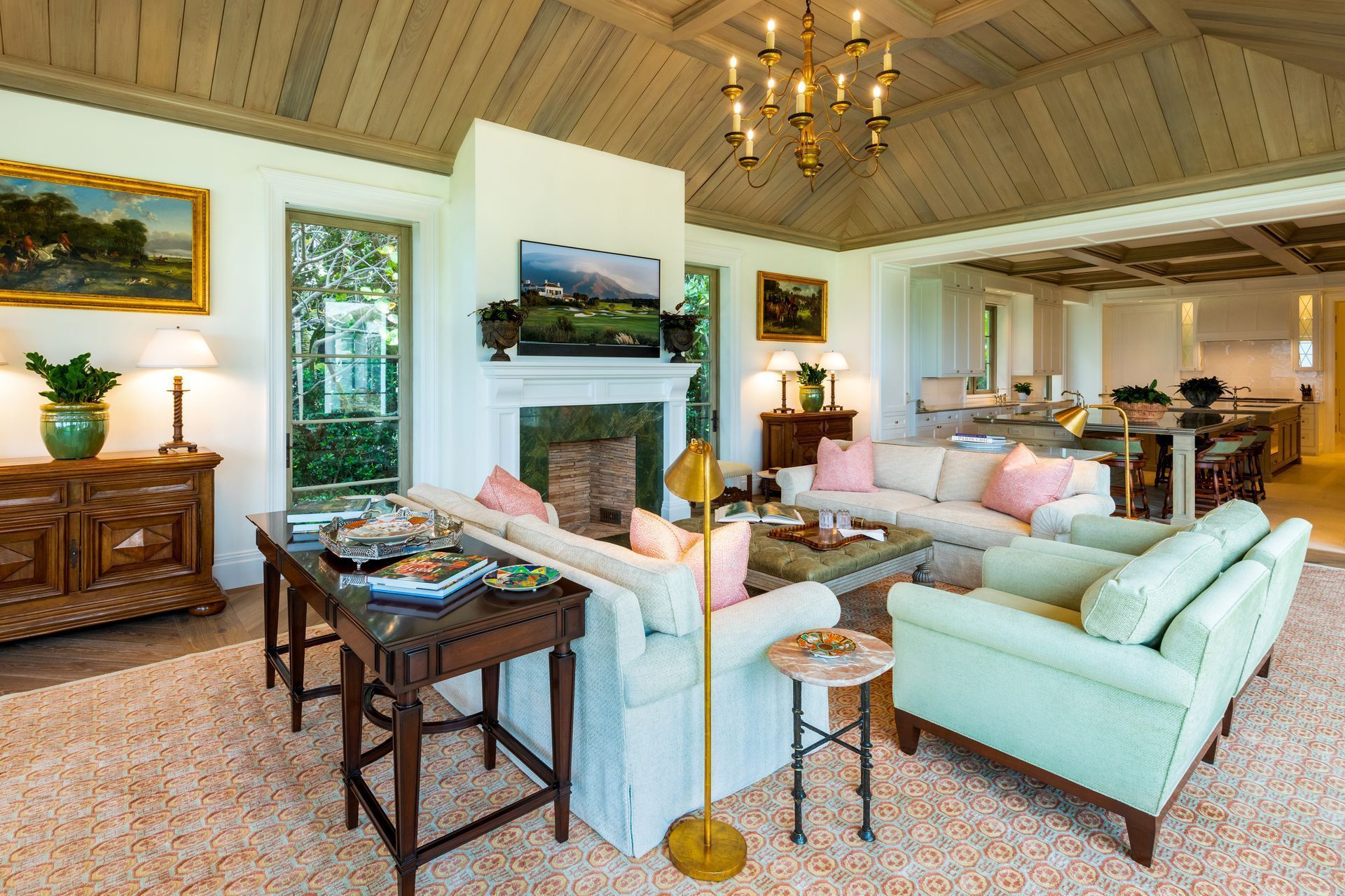
The social areas of The Clubhouse include the main living room, dining room, bar and numerous verandas. The inviting living room features a spacious two-story ceiling with decorative beam detailing. Painted panel moldings enhance the walls and create a graceful contrast to the suave contemporary furnishings, achieving a comfortable yet sophisticated balance. A magnificent antique Baccarat crystal chandelier, a large stone mantel, wide plank hardwood flooring and a custom area rug provide the framework for the living room. Elegant draperies in pale aqua tones, luxurious upholstery fabrics, fine lamps and accessories, a pair of majestic mirrors, and bold, contemporary paintings provide the finishing touches.


The nearby dining room shares the same elegance, with a coffered ceiling, a pale stone mantel hand-carved in England and custom patterned Axminster carpeting. Grand crystal chandeliers illuminate the room, setting off the painted pilasters, wainscoting, artwork, fine consoles and comfortable dining chairs. A similarly elegant private dining room is also available for exclusive parties and events, while outdoor dining is accessible on the adjacent verandas. The handsome bar was designed for casual socializing, utilizing burled walnut paneling, warm-toned supple leather seating and exotic granites to create an intimate gathering space.


Setting the inspiration for the golf course and clubhouse, the 1969 Ryder Cup portrait of Jack Nicklaus and Tony Jacklin is featured in the golf corridor. This grand passageway provides access to the locker room areas, Pro Shop, support spaces and administrative offices. Expansive windows allow abundant natural light to illuminate the trophy cases, golf photos and original Jack Nicklaus hand renderings of The Concession Golf Course. 


Emphasis on the pastoral views of the surrounding impeccably manicured golf course is taken into consideration by the utilization of french doors and large windows within each interior space. Every set of french doors opens to a covered terrace and is framed by simple, yet luxurious drapery panels.


The Concession Golf Clubhouse features richly finished locker rooms for both men and women. The women’s locker room has an elegant Swedish theme with clear pale blue and white tones flowing through the lofty open space. The walls are graced with original pastel drawings, while the wood floor features a custom wool area rug woven in Thailand. The spacious area includes locker and dressing areas, a sitting room, and an elegant bath area finished in Calacatta marble. Dressing and make-up areas are en suite and designed in anticipation of many bridal and evening functions.


In contrast, the men’s locker rooms are a rich environment steeped in the “men’s club” traditional ambience. The main locker room’s expansive gabled ceiling is faced with clear pine tongue and groove paneling and accented by cypress wood beams and massive arched trusses, illuminated by handsome custom pendant light fixtures. Mahogany lockers line the walls and a custom carpet woven in England covers the floor. The space also includes a separate lounge area with full bar, English leather upholstered seating, an abundant amount of television panels for viewing from every location, and multiple card tables. Rainforest green granite on the bar complements the rich wood tones of the walls and ceiling. The custom patterned large-scale area rugs, woven in Turkey, result in a handsome and distinctive gentleman’s lounge environment.


Inviting verandas flow along the rear of the building anchored by cast stone flooring and capped by stained tongue and groove wood ceilings. Just beyond, a large open terrace provides casual golf dining with a fire pit and multiple seating options. An enchanting gazebo is strategically placed nearby for special events.


Even the restrooms are finished in a variety of light and exotic stones and tiles, highlighted with painted or rich wood trim and fine light fixtures and fittings. Attention was paid to every detail and comfort.


Utilized throughout the 33,000 square feet facility are custom light fixtures from Paul Ferrante, an exceptional custom lighting manufacturer. Adrienne, Kevin and I visited the California factory, working with the artisans to custom design each light fixture in order to achieve the correct proportion, scale and custom finish for each piece.


Artwork, mirrors and furniture were also custom designed to fit each location. The designers directed skilled craftsman to create one-of-a-kind pieces throughout The Clubhouse. Rugs were commissioned from looms all over the globe including Turkey, India and Pakistan. Intriguing artwork was found in Sarasota, as well as throughout the United States. Commissioned artwork was executed by David Steiner, Alison Hill, James Kandt and Ted Tihansky.


Capturing the great tradition and the true spirit of the game, The Concession Golf Clubhouse was constructed to exceed expectations and to break new ground. The thoughtful and intentional design of each space is a pure example of staying true to the rich heritage of golf, while at the same time embracing a modern approach to interior design and finish. The Concession Golf Clubhouse is an exceptional collaboration of elegant architectural design, sophisticated furnishings and rich finishes showcasing an innovative design concept.
February 10, 2026
Storage is often treated as a secondary concern in interior design. It is added late in the process, tucked into leftover spaces, or addressed through furniture rather than planning. When storage is handled this way, it tends to feel disconnected from the architecture of a space. In contrast, when storage is treated as an architectural element from the beginning, it becomes integrated, purposeful, and supportive of how a space functions over time. We view storage not as an accessory, but as a fundamental part of spatial planning. Storage Shapes How a Space Is Used The way items are stored directly affects how people move, work, and live within a space. Poorly planned storage often leads to clutter, visual noise, and inefficiency . When belongings do not have a logical place to go, they tend to accumulate in circulation paths or on active surfaces. Integrated storage helps maintain clarity. It supports daily routines by placing frequently used items within reach and less frequently used items out of the way. When storage aligns with actual use patterns, spaces function more smoothly and feel calmer. Architectural Storage Supports Spatial Order Architectural storage is designed as part of the structure of a space rather than applied afterward. This may include built in cabinetry, wall integrated shelving, recessed storage, or millwork that defines zones within an interior. When storage is embedded into walls or volumes, it reinforces spatial order. It can establish boundaries, guide circulation, and contribute to proportion and scale. Instead of interrupting a space, it becomes part of the composition. Reducing Visual Clutter Through Design One of the most effective ways to create visual simplicity is to provide adequate storage that is thoughtfully concealed or integrated. Clutter is often a symptom of insufficient or poorly located storage rather than personal habits alone. Architectural storage allows surfaces to remain clear and spaces to feel intentional. This supports focus and ease of use, particularly in environments where clarity matters, such as workspaces, kitchens, or shared living areas. Storage as a Tool for Flexibility Well designed storage can also support flexibility. As needs change over time, integrated storage systems can accommodate evolving functions without requiring major reconfiguration. For example, storage walls can be designed to adapt to different uses, whether housing files, equipment, or personal items. This adaptability extends the useful life of a space and reduces the need for future renovations. Material and Detail Matter When storage is treated as architecture, material selection and detailing become especially important. Finishes, proportions, and joinery should align with the broader design language of the space. Durable materials help ensure that storage elements age well and continue to perform over time. Attention to detail reinforces the idea that storage is not an afterthought, but a deliberate part of the interior. Storage Influences How Spaces Feel Beyond function, storage plays a role in how spaces are perceived. Integrated storage can make rooms feel more generous by reducing visual interruption. It can also contribute to rhythm and balance through repetition and alignment. Thoughtful storage design helps spaces feel composed rather than crowded. This sense of order supports comfort and usability on a daily basis. Planning Storage From the Start The most successful storage solutions are developed early in the design process. This allows storage needs to inform layout decisions rather than compete with them. By considering storage alongside circulation, lighting, and structure, we are able to create interiors that support both present needs and future adaptability. Designing With Intent When storage is approached as an architectural element, it becomes more than a place to put things. It becomes part of how a space works, feels, and endures.  Treating storage with the same level of intention as other architectural components allows interiors to function more effectively and remain cohesive over time. It is one of the quiet design decisions that has a lasting impact on how people experience space every day.
February 3, 2026
Creating an interior that feels both engaging and calm requires careful balance. Too much visual stimulation can feel chaotic, while too much restraint can feel flat or unfinished. The goal is not to strip a space of character, but to shape it intentionally so that interest and simplicity work together rather than compete. Achieving this balance starts with understanding how people experience space on a daily basis. Why Visual Interest Matters Visual interest gives a space personality. It draws the eye, creates moments of discovery, and prevents interiors from feeling sterile. This interest can come from texture, contrast, scale, or thoughtful variation in materials. Without visual interest, a space may feel unfinished or overly utilitarian. People often respond to this by adding decor incrementally, which can lead to clutter rather than cohesion. Intentional design allows interest to be built into the structure of the space instead of relying on surface additions. Why Simplicity Is Essential Simplicity provides clarity. It allows the eye to rest and helps people feel grounded in a space. When too many elements compete for attention, even well chosen pieces can lose their impact. Simplicity does not mean minimalism. It means restraint . Each element has a reason for being present and contributes to the overall composition. When unnecessary elements are removed, the remaining ones become more powerful. Establishing a Clear Hierarchy One of the most effective ways to balance interest and simplicity is by establishing hierarchy . Not every element needs to be a focal point. Successful interiors often have one or two primary features supported by quieter secondary elements. This hierarchy guides how the space is read. The eye knows where to land first, then where to move next. Without this structure, interiors can feel visually noisy even when individual components are attractive. Using Texture Instead of Excess Texture is a powerful tool for creating interest without adding clutter. Subtle variation in materials such as wood grain, stone finishes, textiles, or wall treatments adds depth without overwhelming the space. Texture works best when it is layered thoughtfully. When too many textures are introduced at once, the effect can feel busy. Limiting the palette while varying surface quality allows interest to emerge naturally. Letting Negative Space Do Its Work Negative space is just as important as what is filled. Empty space allows design elements to breathe and gives visual weight to what remains. It also supports functionality by preventing interiors from feeling crowded or restrictive. Resisting the urge to fill every wall or surface often results in a more composed and comfortable environment. Negative space creates rhythm and balance, especially in rooms that serve multiple purposes. Color as a Unifying Element Color can either calm or energize a space depending on how it is used. A restrained color palette helps unify diverse elements and prevents visual fragmentation. Interest can still be introduced through variation in tone, saturation, or finish rather than constant color changes. When color is used strategically, it reinforces cohesion while allowing individual features to stand out in meaningful ways. Designing for Daily Use Spaces should support how people live and work, not just how they look. Visual interest that interferes with function quickly becomes a distraction. Simplicity helps interiors remain usable and comfortable over time. Designing with daily routines in mind ensures that interest enhances experience rather than competing with it. A Measured Approach Creates Lasting Design Balancing visual interest with simplicity is about intention. Every choice should support the whole rather than draw attention to itself unnecessarily. When design decisions are measured and purposeful, interiors feel both engaging and restful. The most successful spaces do not demand attention. They invite it naturally, offering richness without excess and clarity without monotony.
January 27, 2026
Every successful interior begins long before materials are selected or drawings are finalized. The foundation of an effective space is not a color palette or a furniture layout, but the quality of the questions asked at the outset of the project. Thoughtful questioning shapes decisions, clarifies priorities, and ultimately determines whether a space supports the people who use it or simply looks finished. Design that performs well over time is rooted in understanding, not assumptions. Questions Define the Problem Being Solved Design challenges are rarely as simple as they appear. A request for a refreshed interior may actually reflect deeper concerns about workflow, growth, culture, or usability. Without careful questioning, surface level solutions risk addressing symptoms rather than causes. Asking the right questions helps define what the project truly needs to accomplish. How is the space used throughout the day? Where do bottlenecks occur? What activities are growing or changing? These inquiries reveal functional requirements that may not be visible in an initial walkthrough. Clear problem definition prevents misalignment later in the process. Understanding People Before Spaces Interiors exist to support people, not the other way around. Asking better questions means learning how individuals and groups interact with their environment . This includes understanding routines, collaboration styles, privacy needs, and physical demands. When designers ask how people move, communicate, and focus within a space, layouts become more intuitive. Circulation improves. Work areas feel purposeful rather than arbitrary. These outcomes are the result of listening carefully rather than imposing predetermined solutions. Design informed by human behavior tends to feel effortless, even when it is highly intentional. Context Matters More Than Trends Trends can be useful references, but they are rarely a substitute for context. Asking better questions shifts the focus away from what is popular and toward what is appropriate. What is the lifespan of the space? How often will it change? What level of durability is required? What constraints exist that must be respected? These questions guide material selection, detailing, and planning decisions. They also help avoid design choices that age poorly or fail under real use conditions. Context driven design is less about visual novelty and more about long term relevance. Aligning Design With Organizational Goals Interior environments often reflect organizational values, whether intentionally or not. Asking better questions allows design to align with broader goals such as productivity, collaboration, inclusivity, or client experience. What behaviors should the space encourage? What impression should it leave? How should it support future growth? These considerations influence everything from spatial hierarchy to lighting strategy. When design decisions are connected to organizational purpose, the result feels cohesive and intentional. Reducing Rework and Uncertainty Clear questions at the beginning reduce costly changes later. When priorities are defined early, design development becomes more efficient. Fewer assumptions mean fewer revisions driven by late discoveries. Asking better questions also helps clients articulate preferences they may not initially know how to express. This shared understanding builds confidence and reduces decision fatigue as the project progresses. Clarity early in the process saves time, resources, and frustration. Design as a Collaborative Process Successful interiors emerge from collaboration rather than prescription. Asking thoughtful questions invites dialogue and shared ownership. It positions design as a process of discovery rather than a fixed solution delivered from outside. This approach respects the expertise of those who know the space best while applying professional insight to translate needs into form. Collaboration strengthens outcomes because it grounds creativity in reality. Better Questions Lead to Better Results Design is often judged by what is visible, but its success is determined by what is understood. Spaces that function well over time are the result of careful listening, thoughtful inquiry, and deliberate choices. By prioritizing better questions at the beginning of a project, interiors gain clarity, purpose, and longevity. The result is not just a well designed space, but one that continues to support its users long after completion.  In the end, the quality of the questions asked shapes the quality of the space that follows.